
- Buy Crypto
- Markets
- Futures
- Spot
- Copy Trade
 Earn
Earn- More
Why Did the Crypto Market Lose $900 Billion While Stablecoin Market Cap Hit an All-Time High?

Since Trump took office, the total market value of cryptocurrency has evaporated by nearly $900 billion, but the total market value of stablecoins has increased by 1.03% in the past week, surpassing $227 billion to hit a historical high. The community can't help but wonder what factors are driving the market value of stablecoins to rise against the trend?
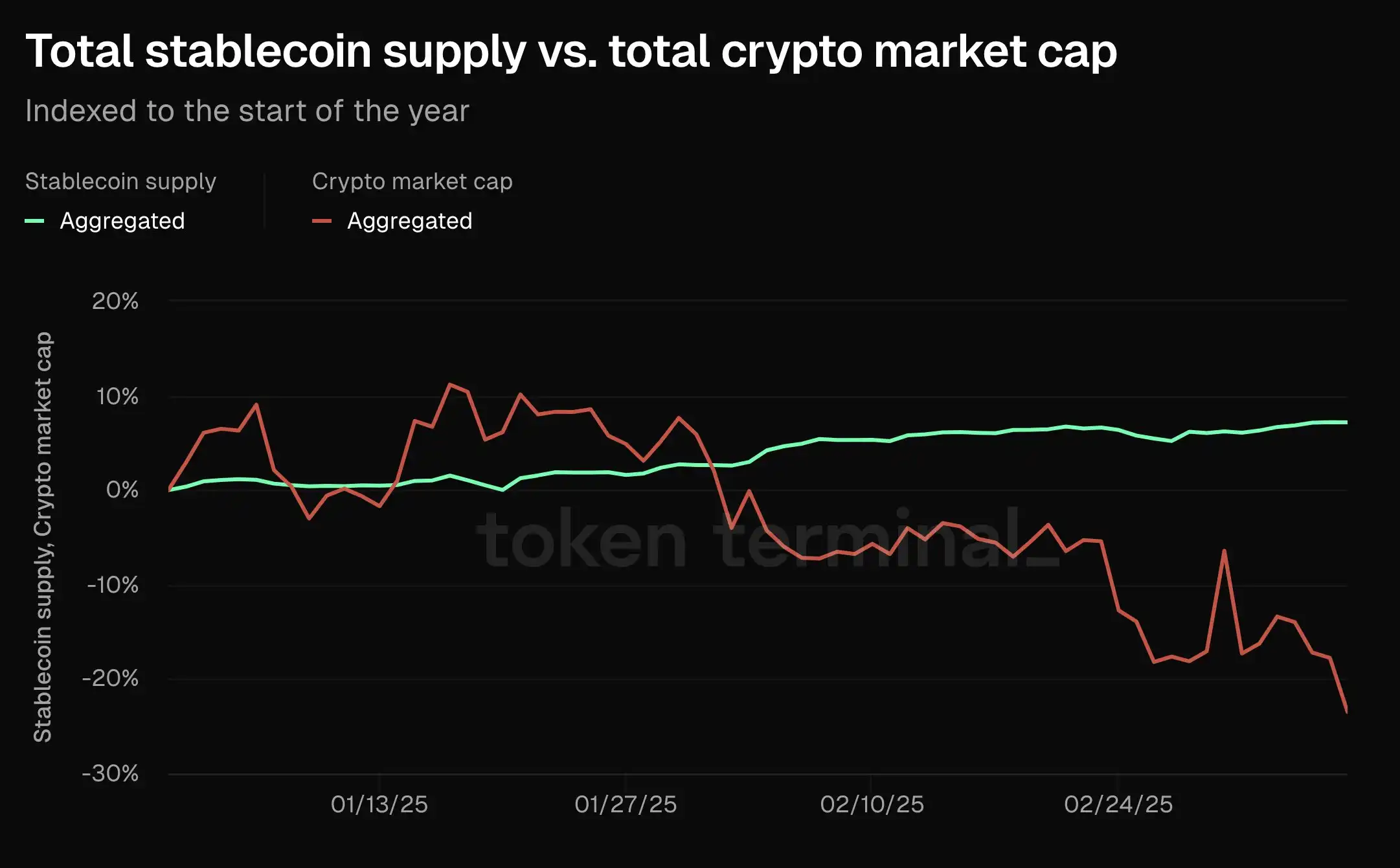
As the market value of stablecoins hits a historical high, Frax Finance co-founder Sam tweeted that a bear market is a bull market for stablecoins. He said, "Another way to describe a price drop is a rise in the value of the U.S. dollar. In these environments, on-chain dollar issuers will receive the most benefits, especially as favorable regulation is imminent."
Recently, CryptoQuant CEO Ki Young Ju also wrote an analysis stating that the capital flow cycle of past altcoin seasons is outdated. "The rotation of crypto assets dominated by Bitcoin has essentially ended under the drive of regulation and institutional adoption. New capital will flow through stablecoins or widely adopted altcoins — a scenario completely different from traditional altcoin seasons."
Against the backdrop of cryptocurrency assets and U.S. stocks trending downward and under pressure, stablecoins rising against the trend to consolidate the dominance of the U.S. dollar may have become the biggest winner in the recent market turmoil.
Regulatory Easing
On February 27, U.S. crypto-friendly Senator Cynthia Lummis stated at the first hearing of the Senate Banking Subcommittee on Digital Assets that "we are about to develop a bipartisan legislative framework for stablecoins and market structure."
At a White House inaugural crypto summit last Friday with little news coverage, Trump expressed his hope to receive a stablecoin legislative bill before the August congressional recess to advance federal government regulatory reform of cryptocurrency and reiterated his wish for the dollar to "remain dominant in the long run."
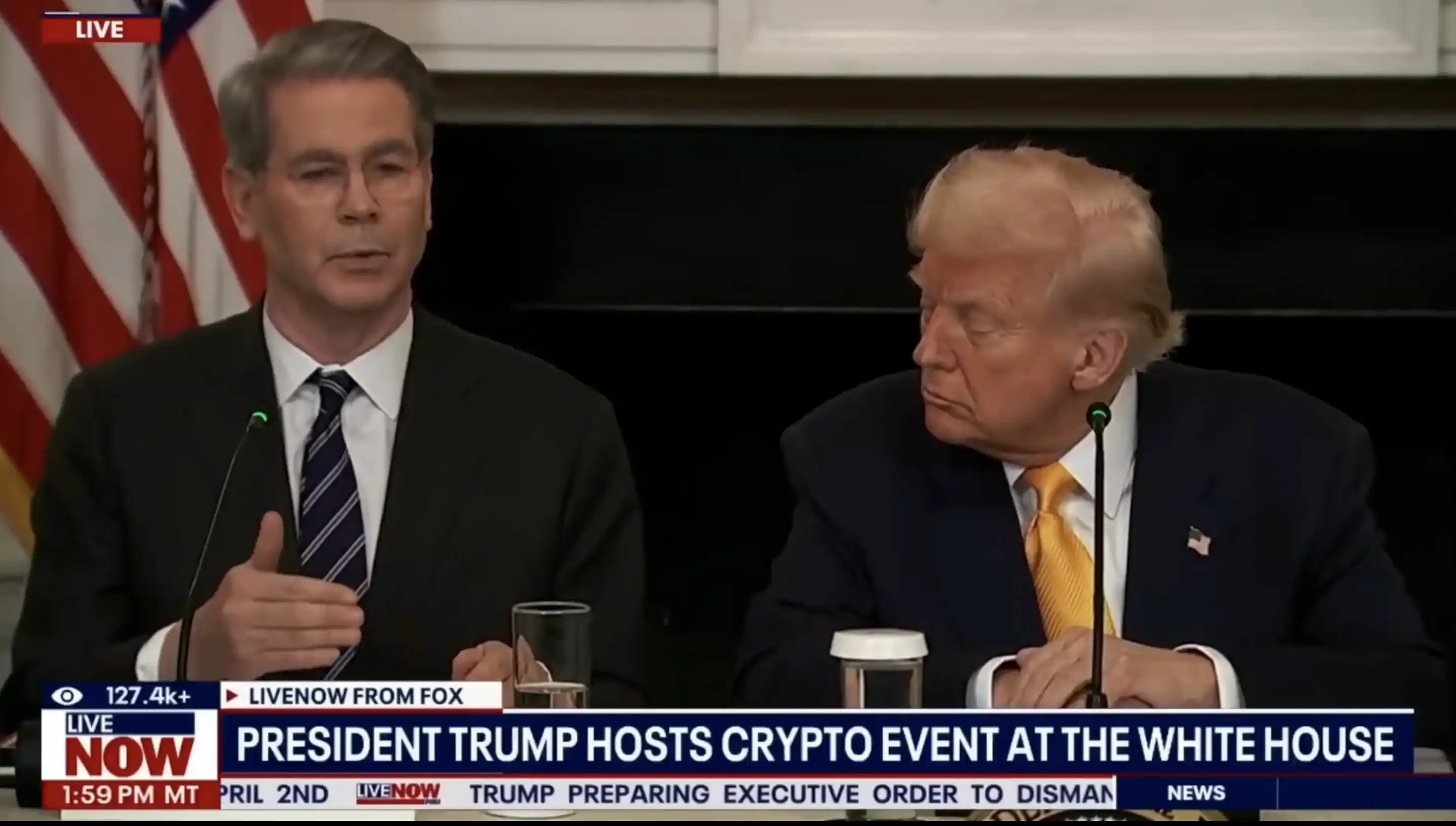
U.S. Treasury Secretary Scott Bessent pledged to strengthen the global reserve currency status of the dollar using digital assets, stating, "We will deeply consider the stablecoin system. As President Trump has directed, we will maintain the U.S. as the world's leading reserve currency and will use stablecoins to achieve that."
This statement highlights the U.S. government's concerns about macroeconomic and geopolitical uncertainties, which may lead to decreased demand from foreign investors for U.S. bonds, thereby pushing up bond yields. In the past year, the top two holders of U.S. debt, Japan and China, have continued to reduce their holdings. To maintain the global reserve currency status of the dollar, it is necessary to ensure a sustained demand for U.S. bonds in the international market.
By holding US Treasury bonds as reserve assets, stablecoins can help lower bond yields and simultaneously expand the global circulation of the US dollar. Stablecoins need to hold sufficient reserves in US dollars to meet investor redemption demands, with Tether currently being one of the largest holders of three-month US Treasury bonds.
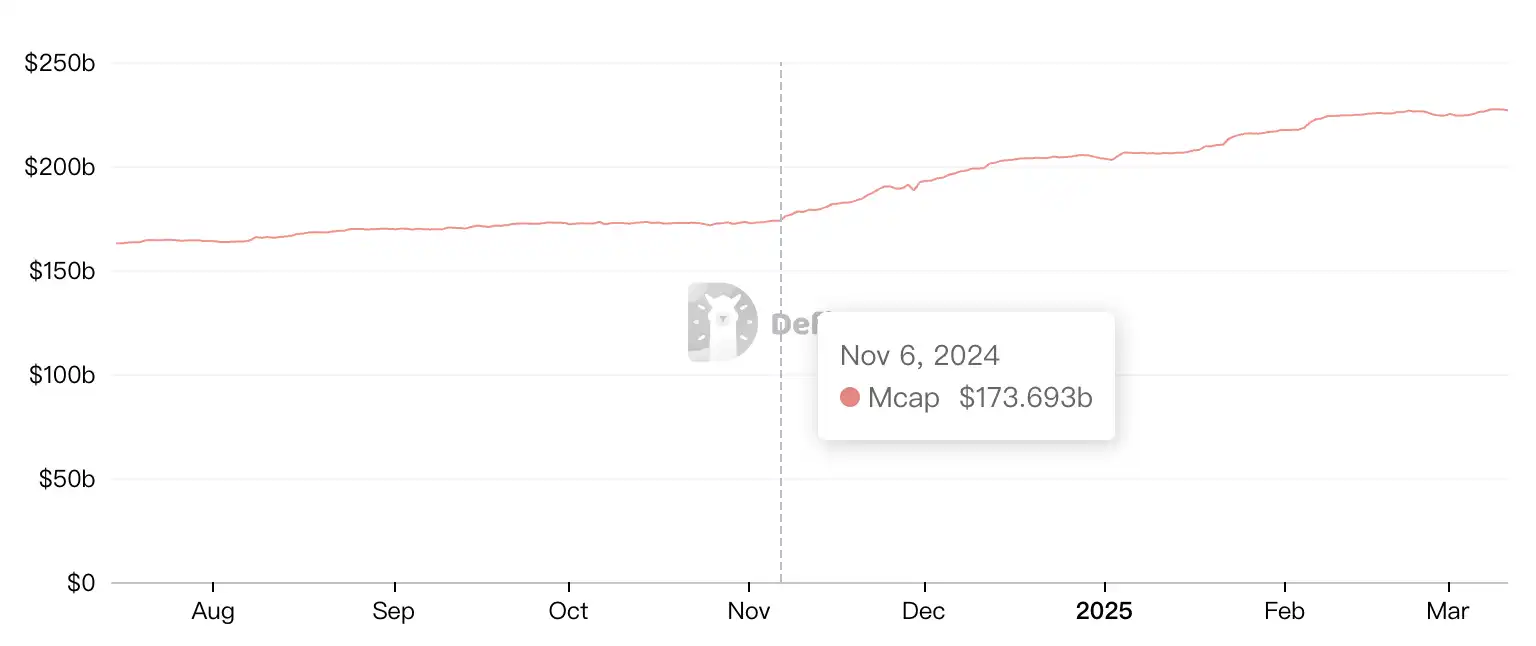
The total market value of stablecoins has surged by $500 billion since Trump's election; Source: DeFiLlama
On a policy level, the US has proposed two stablecoin bills—the House's \"Stablecoin Tethering and Bank Licensing Enforcement (STABLE) Act\" and the Senate's \"Guaranteeing Easy Access to Nurturing Investment in Stablecoins (GENIUS) Act\"—aimed at regulating stablecoin issuers through licensing requirements, risk management rules, and 1:1 reserve backing.
These two bills present different frameworks but converge on stringent compliance measures. Both support private, USD-backed stablecoins and prohibit central bank digital currencies (CBDCs).
Key differences include:
· Regulatory oversight (GENIUS allows states to regulate issuers until the market value reaches $10 billion; STABLE allows opting out of federal oversight if state-level rules meet the criteria)
· Reserve requirements (STABLE allows the use of Treasury bonds, bank deposits, and central bank reserves, while GENIUS also includes money market funds and reverse repurchase agreements)
· Consumer protection (GENIUS focuses on transparency and enforcement, while STABLE requires a one-to-one reserve and prohibits algorithmic stablecoins)
Stricter regulations could challenge Tether's dominant position, as both bills mandate monthly audits, asset segregation, and strict reporting, potentially forcing exchanges to delist non-compliant stablecoins, similar to the impact of the EU's MiCA. These laws would also pave the way for the legalization of stablecoins, attracting institutional adoption while creating barriers for less transparent issuers. If passed, they would provide clear guidelines for stablecoin issuers, ensuring market stability and compliance.
This morning, FOX Business reporter Eleanor Terrett posted on social media, saying, \"As far as I know, an updated version of US Republican Senator Bill Hagerty's stablecoin bill—the GENIUS Act—is set to be released tonight (local time). As of this morning, the US Senate Banking Committee still plans to mark up the bill on Thursday.\"
The new version of the document extends the mutual clause for overseas payment stablecoins, adding reserve requirements, regulation, anti-money laundering and counter-terrorism measures, sanctions compliance, liquidity requirements, and risk management standards, aiming to promote international transactions and achieve interoperability with overseas USD-priced payment stablecoins.
Stablecoin FOMO Wave is Coming, What Are the Future Opportunities?
Against the backdrop of Trump's explicit statement hoping to clarify stablecoin-related legislation by August, efforts have been made by countries including Japan, Thailand, and U.S. government departments for stablecoin adoption.
On March 10, the Thai Securities and Exchange Commission has designated stablecoins USDT and USDC as compliant cryptocurrencies. This approval means that USDT and USDC can be legally traded in Thailand, paving the way for the listing of stablecoins on regulated trading platforms in Thailand, and also laying the foundation for the widespread application of USDT and USDC in the Thai payment field.
On the same day, the Japanese Cabinet announced approval of a proposal to reform laws related to cryptocurrency brokers and stablecoins. According to the announcement by the Financial Services Agency (FSA) of Japan, the government has approved a cabinet resolution to amend the Payment Services Act. This legislation will allow crypto companies to operate as "intermediary businesses." This means brokers will no longer need to apply for the same type of license as cryptocurrency exchanges and wallet operators. The bill also provides more flexibility for stablecoin issuers in terms of the asset types supporting their tokens.
According to the Financial Times, some of the world's largest banks and fintech companies are eager to launch their stablecoins, aiming to capture the cross-border payment market share they expect to be reshaped by cryptocurrencies.
Last month, Bank of America stated its intention to issue its own stablecoin, joining established payment providers such as Standard Chartered, PayPal, Revolut, and Stripe in the race to compete with cryptocurrency groups led by Tether and Circle.
This shift comes six years after regulatory agencies strongly opposed Meta's Libra stablecoin, and it has received further support from U.S. President Trump endorsing cryptocurrency. "It's like selling shovels in a gold rush of stablecoins," said Simon Taylor, co-founder of the fintech consultancy 11:FS, likening it to FOMO.
In addition to Bank of America, other major Traditional Finance (TradFi) players are also gearing up for the development of stablecoins.
- Standard Chartered Bank: Advancing the Hong Kong Dollar stablecoin project
· PayPal: Plans to Expand the Issuance of PYUSD by 2025
· Stripe: Acquires Bridge Stablecoin Platform for $1.1 Billion
· Revolut: Exploring the Possibility of Issuing a Stablecoin
· Visa: Using Stablecoins for Payments and Global Business
Prior to this, the increase in stablecoin supply has often driven up cryptocurrency prices, as these tokens are primarily used as short-term holding instruments for transactional purposes. Now, the application of stablecoins is breaking through the realm of speculation—SpaceX uses stablecoins for refunds in Argentina and Nigeria through its Starlink service; ScaleAI uses them to pay overseas contractor wages.
The most direct trading opportunity lies in betting on which mainstream institutions will choose which public blockchains to issue new stablecoins on. Currently, Ethereum, Base, Tron, and Solana are the main alternative public blockchains. On February 26, Jesse Pollak, the head of the Base protocol, stated that this year they plan to launch a stablecoin for all global currencies on Base.
It is clear that both the on-chain world and traditional finance are strategizing around U.S. and USD-backed stablecoins. As for the altseason, it may be as CryptoQuant's CEO said—the capital flow cycle of past altseasons is outdated.
You may also like

Russia’s Largest Bitcoin Miner BitRiver Faces Bankruptcy Crisis – What Went Wrong?
Key Takeaways BitRiver, the largest Bitcoin mining operator in Russia, faces a bankruptcy crisis due to unresolved debts…

Polymarket Predicts Over 70% Chance Bitcoin Will Drop Below $65K
Key Takeaways Polymarket bettors forecast a 71% chance for Bitcoin to fall below $65,000 by 2026. Strong bearish…

BitMine Reports 4.285M ETH Holdings, Expands Staked Position With Massive Reward Outlook
Key Takeaways BitMine Immersion Technologies holds 4,285,125 ETH, which is approximately 3.55% of Ethereum’s total supply. The company…

US Liquidity Crisis Sparked $250B Crash, Not a ‘Broken’ Crypto Market: Analyst
Key Takeaways: A massive $250 billion crash shook the cryptocurrency markets, attributed largely to liquidity issues in the…

Vitalik Advocates for Anonymous Voting in Ethereum’s Governance — A Solution to Attacks?
Key Takeaways Vitalik Buterin proposes a two-layer governance framework utilizing anonymous voting to address collusion and capture attacks,…

South Korea Utilizes AI to Pursue Unfair Crypto Trading: Offenders Face Severe Penalties
Key Takeaways South Korea is intensifying its use of AI to crack down on unfair cryptocurrency trading practices.…

Average Bitcoin ETF Investor Turns Underwater After Major Outflows
Key Takeaways: U.S. spot Bitcoin ETFs hold approximately $113 billion in assets, equivalent to around 1.28 million BTC.…

Japan’s Biggest Wealth Manager Adjusts Crypto Strategy After Q3 Setbacks
Key Takeaways Nomura Holdings, Japan’s leading wealth management firm, scales back its crypto involvement following significant third-quarter losses.…
CFTC Regulatory Shift Could Unlock New Opportunities for Coinbase Prediction Markets
Key Takeaways: The U.S. Commodity Futures Trading Commission (CFTC) is focusing on clearer regulations for crypto-linked prediction markets,…
Hong Kong Set to Approve First Stablecoin Licenses in March — Who’s In?
Key Takeaways Hong Kong’s financial regulator, the Hong Kong Monetary Authority (HKMA), is on the verge of approving…

BitRiver Founder and CEO Igor Runets Detained Over Tax Evasion Charges
Key Takeaways: Russian authorities have detained Igor Runets, CEO of BitRiver, on allegations of tax evasion. Runets is…

Crypto Investment Products Struggle with $1.7B Outflows Amid Market Turmoil
Key Takeaways: The recent $1.7 billion outflow in the crypto investment sector represents a second consecutive week of…

Why Is Crypto Down Today? – February 2, 2026
Key Takeaways: The crypto market has seen a downturn today, with a significant decrease of 2.9% in the…

Nevada Court Temporarily Bars Polymarket From Offering Contracts in the State
Key Takeaways A Nevada state court has temporarily restrained Polymarket from offering event contracts in the state, citing…

Bitcoin Falls Below $80K As Warsh Named Fed Chair, Triggers $2.5B Liquidation
Key Takeaways Bitcoin’s price tumbled below the crucial $80,000 mark following the announcement of Kevin Warsh as the…

Strategy’s Bitcoin Holdings Face $900M in Losses as BTC Slips Below $76K
Key Takeaways Strategy Inc., led by Michael Saylor, faces over $900 million in unrealized losses as Bitcoin price…
Trump-Linked Crypto Company Secures $500M UAE Investment, Sparking Conflict Concerns
Key Takeaways A Trump-affiliated crypto company, World Liberty Financial, has garnered $500 million from UAE investors, igniting conflict…

Billionaire Michael Saylor’s Strategy Buys $75M of More Bitcoin – Bullish Signal?
Key Takeaways Michael Saylor’s firm, Strategy, has significantly increased its Bitcoin holdings by acquiring an additional 855 BTC…
Russia’s Largest Bitcoin Miner BitRiver Faces Bankruptcy Crisis – What Went Wrong?
Key Takeaways BitRiver, the largest Bitcoin mining operator in Russia, faces a bankruptcy crisis due to unresolved debts…
Polymarket Predicts Over 70% Chance Bitcoin Will Drop Below $65K
Key Takeaways Polymarket bettors forecast a 71% chance for Bitcoin to fall below $65,000 by 2026. Strong bearish…
BitMine Reports 4.285M ETH Holdings, Expands Staked Position With Massive Reward Outlook
Key Takeaways BitMine Immersion Technologies holds 4,285,125 ETH, which is approximately 3.55% of Ethereum’s total supply. The company…
US Liquidity Crisis Sparked $250B Crash, Not a ‘Broken’ Crypto Market: Analyst
Key Takeaways: A massive $250 billion crash shook the cryptocurrency markets, attributed largely to liquidity issues in the…
Vitalik Advocates for Anonymous Voting in Ethereum’s Governance — A Solution to Attacks?
Key Takeaways Vitalik Buterin proposes a two-layer governance framework utilizing anonymous voting to address collusion and capture attacks,…
South Korea Utilizes AI to Pursue Unfair Crypto Trading: Offenders Face Severe Penalties
Key Takeaways South Korea is intensifying its use of AI to crack down on unfair cryptocurrency trading practices.…


 App
App