
- Buy Crypto
- Markets
- Futures
- Spot
- Copy Trade
 Earn
Earn- More
KOL Cycle: From Win-Win Tool to Multi-Loss Trap

Original Title: "When KOLs Fight for 'KOL Rounds' Rights, There Are No Winners in a Bear Market Anymore"
Original Source: Deep Tide TechFlow
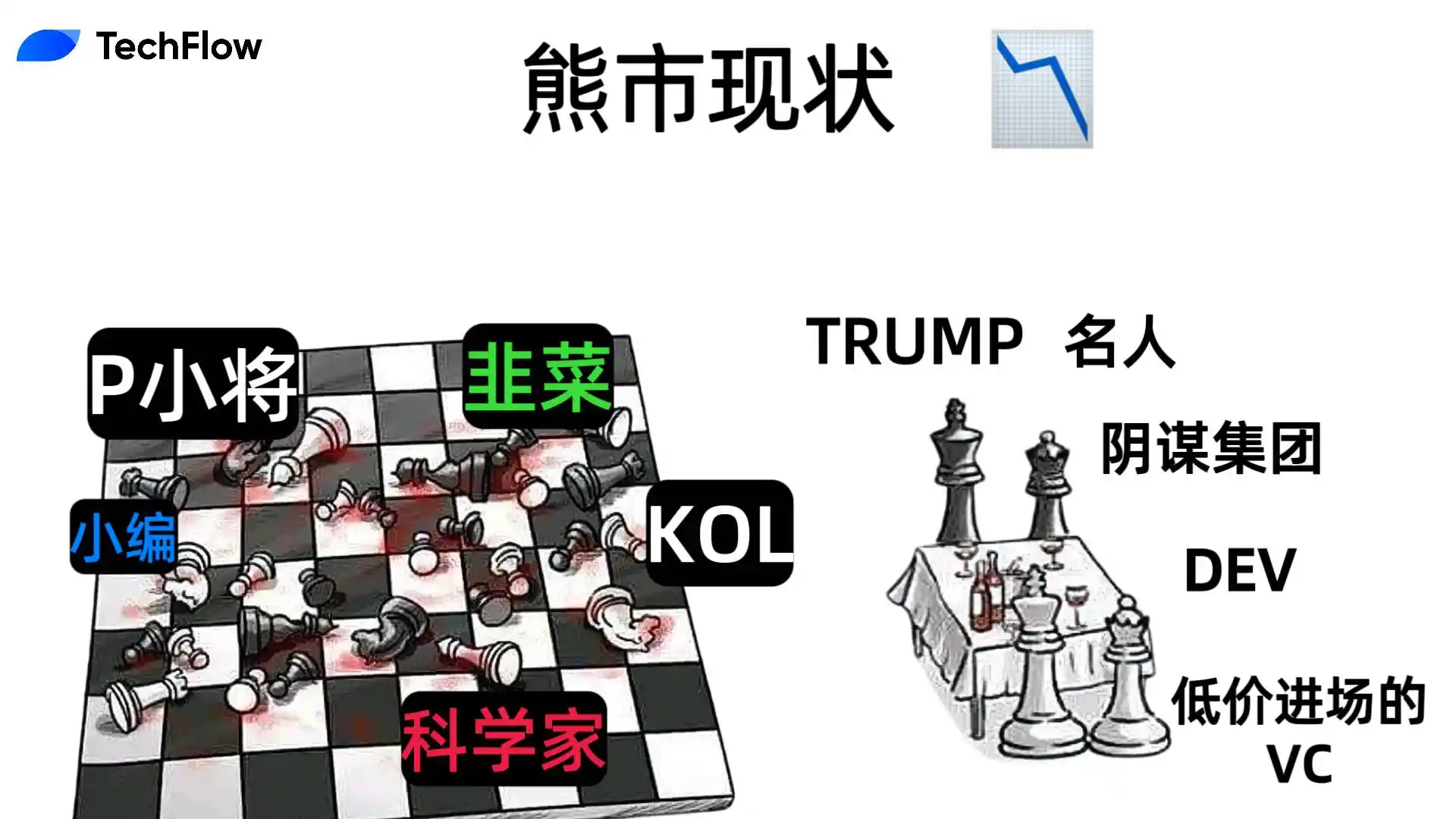
Presidential NFT scandals, celebrity token launches, long and short liquidations, AI disappointments... From the beginning of the year to the present, any of these incidents in the crypto market are enough to make the general public suffer.
As a seasoned member of the general public, it's challenging to avoid drinking from these incidents --- not having enough information, following the crowd blindly, trading without discipline, and so on. These weaknesses are more easily magnified during Scam Season and a bear market, making loss a high-probability event.
But it's not just the general public who gets hurt.
When the market is down, most people, no matter how hard they try, are unlikely to be winners, including even KOLs.
KOLs, who have always been seen as being on the same side as project teams to reap rewards, have also started losing money and lamenting in this bull-to-bear cycle;
And what has turned them into "major league members of the general public" is something they once didn't miss the opportunity to touch, but now has become a hot potato:
KOL Rounds.
KOL Rounds: From a Win-Win Tool to a Multi-Loss Trap
Bear markets involve a lot of infighting and calls for rights, but no one expected KOLs to start advocating for their own rights.
On March 4, 2025, ChainDoctor sighed, "Don't envy KOL Rounds. I invested in over ten KOL Rounds last year, and all of them lost money. Most of them didn't even issue tokens; they just disappeared."
Perhaps KOLs have a higher tolerance for losses than the general public, but this does not change the fact that they are also losing money.
You can certainly view it as a performance and act of self-pity, but many KOLs' venting only serves to indirectly prove that they have indeed fallen into a pit.
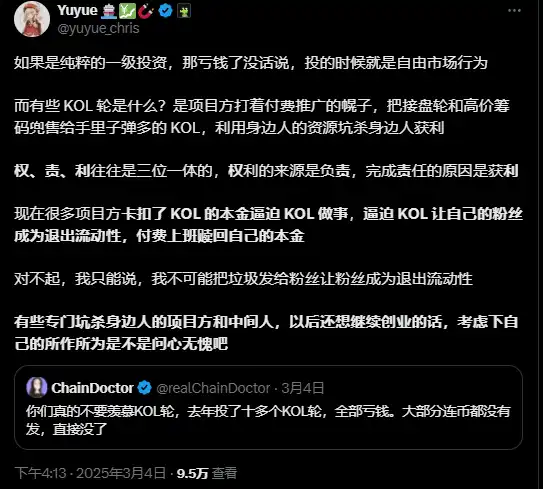
After this post was made, various influential KOLs in the Chinese crypto community began a collective criticism and mockery of KOL Rounds in the following days. For example, renowned KOL yuyue straightforwardly criticized:
"Some KOL Rounds are disguised by project teams as paid promotions, where they sell the private sale round and overpriced fundraising to KOLs, taking advantage of the resources of those around them to profit at their expense..."
You might still question the logic behind KOLs losing money, but in the entire token listing chain, KOLs are actually positioned downstream in the ecosystem.
The entire chain usually includes:
Seed Round (early investors such as friends and family participating), Private Sale Round (targeting venture capitalists and strategic partners), KOL Round (project team selling tokens to KOLs at a discounted price in exchange for promotion), Public Sale Round (retail investors), and Exchange Listing (token being listed for trading).
The KOL Round usually appears after the Private Sale Round, where the project team sells tokens to KOLs at a low price or discounted price, and KOLs use their influence on platforms like X and Telegram to promote the project, thus increasing the project's visibility.
In a bull market, the KOL Round may be a win-win tool. The project team raises funds through the KOL Round, KOLs earn money through the token's cost price and secondary price difference, and retail investors may also benefit when the market conditions are favorable.
However, in a bear market, the situation is not as optimistic.
Liquidity dries up, secondary market trading volume shrinks, token prices plummet, project teams often cash out early and exit, while KOLs are left with locked tokens—a lock-up period usually lasting 3 to 6 months that prevents KOLs from selling in a timely manner, leading to the token's value plummeting to zero.
In the post above, you can also see sharp comments:
"Nowadays, the KOL Round is already a typical scenario of losing both money and troops. When the project team can't raise funds or can't engage in secondary selling, they target KOLs who eat up advertising costs. KOL is equivalent to putting in money, effort, and people."
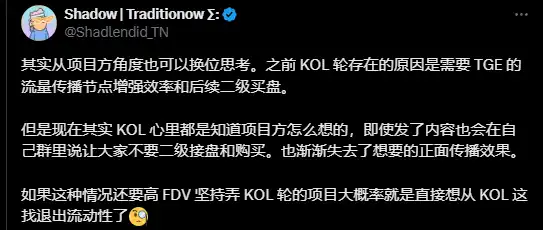
This is no longer a passive stage where the market conditions are poor, and everyone understands each other. Instead, certain project teams have even taken the initiative to act maliciously, considering KOLs as part of the liquidity exit as well.
What's even worse is that KOLs are also facing a dilemma: project teams know the risks of this model, and KOLs are aware as well, but they still use KOLs' greed or survival pressure (demand for monetizing traffic) to drive cooperation. KOLs hope to "give it a try," but the outcome often turns out contrary to their wishes.
On the other hand, retail investors have reduced their blind trust in KOLs, and a "reverse indicator" phenomenon has even emerged (projects recommended by KOLs are viewed as likely to fall). As KOLs' promotional effectiveness declines, token prices struggle to rise, further exacerbating damage to their reputation.
If we don't consider making a quick profit and leaving, who wouldn't want to cherish their feathers and make money together with everyone?
From Win-Win Tools to Multi-Loss Traps, in a bear market, most of those standing downstream in the value chain may no longer have any winners.
Agency, the Professionalism of a Broker
You may not know this, but behind the scenes of the crypto market's KOL circle, there is another lesser-known role: the Agency.
In simple terms, their responsibility is to take on the promotional needs of the project team, help find suitable KOLs in the market for promotion.
However, the Agency's duties go far beyond mere matchmaking. They need to balance the interests of the project team—who hope to attract maximum traffic at the lowest cost—and the demands of the KOLs—who seek stable income through promotion, breaking even or even making a profit.
For example, a representative of the Agency, Dov, posted:
"I have never let my KOLs lose any money. Either I pay for direct promotion through U, or the KOL has a guaranteed minimum for the round, and in the worst case, the principal is returned."
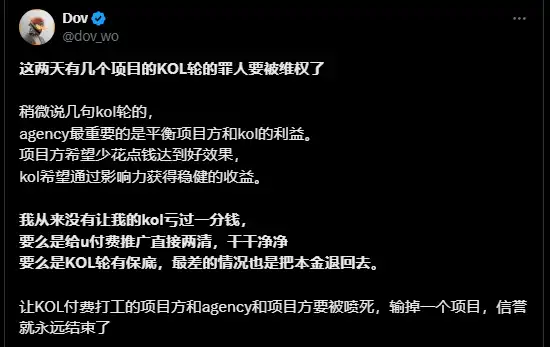
From here, you can see that the motivations and business capabilities of any practitioner in the crypto ecosystem are actually varied.
An excellent Agency will try to consider a guarantee mechanism to ensure that KOLs do not lose money, such as direct cash payment or returning the KOL's principal. However, if an Agency lacks professional judgment and selects low-quality projects, KOLs may face token depreciation, lock-up risks, and ultimately losses.
The fate of the doer often depends on the professionalism of the sender.
In this chain of crypto marketing, perhaps only scammers hope to engage in a "one-off deal." Continuing to deceive one after another will only result in less business and a narrower path.
After all, no one is a fool, and sustainable win-win situations are the way to prosperity.
But perhaps everyone is a good broker in the downstream, yet seemingly inevitably becomes a victim in the upstream.
No Winners, but No Endgame Either
The cruelty of a bear market lies in the fact that it not only makes ordinary investors (the lambs) feel the market's chill but also forces KOLs who once stood at a higher point in the profit chain to face reality.
In this cycle of bull and bear, project teams, KOLs, retail investors, and even Agencies are playing different roles, but ultimately there are no winners.
A Key Opinion Leader's "Rights Protection" is actually a microcosm of the entire crypto ecosystem.
From a "win-win tool" in a bull market to a "multi-loss trap" in a bear market, the transformation of KOL circles has exposed a deep-seated trust crisis in the crypto market. The short-sighted behavior of project teams, the profit-driven mentality of KOLs, the blind follow-the-crowd behavior of retail investors, and even the inadequate professional capabilities of agencies have all been magnified in this game.
When the market is trending downward, everyone is trying to protect themselves but struggling to escape the fate of being harvested.
The "harvesting" of KOLs is not just a simple dispute over benefits but a manifestation of the ecosystem imbalance in the crypto market during a bear market environment. When liquidity dries up and the fund chain breaks, all roles downstream of the value chain become passive sacrifices.
In retrospect, the controversy surrounding KOL circles is essentially a growing pain in the industry's development.
When KOLs stand up for their rights, they are also indirectly speaking up for the entire ecosystem. Perhaps only after experiencing such a bear market can everyone truly understand that in a market without rules and trust, short-term winners will ultimately become long-term losers.
However, from a longer-term perspective, this may also be an opportunity for reshuffling. The market's nadir is often the starting point for ecosystem optimization. Only through reflection and adjustment in pain can the next round of prosperity be ushered in.
Will the next bull market arrive as expected? Perhaps it depends on whether every participant today can truly learn from the lessons of this bear market, find a new balance of "win-win."
You may also like

What Happened in Crypto Today? Solana-Native Rails Launch on Digitap ($TAP) as the Best Crypto to Buy
Key Takeaways Digitap ($TAP) spearheads the transition toward real-world utility in cryptocurrency, offering a seamless financial ecosystem through…

Here’s Why Fed Contender Kevin Warsh is Seen as Bearish for Bitcoin
Key Takeaways Kevin Warsh is a potential nominee for the U.S. Federal Reserve chair, causing concerns due to…

XRP Breaks Below Its 1-Year Support Range: What’s Next?
Key Takeaways XRP has slipped below its critical support range of $1.8 to $2.1, which had been steadfast…

XRP Price Breakdown Intensifies — Can Support Mitigate the Shock?
Key Takeaways XRP has dipped below the significant $1.80 mark, continuing its downtrend. The asset is trading beneath…

XRP Risk-Adjusted Returns Suggest a Period of Consolidation – Insights and Analysis
Key Takeaways: XRP’s recent price fluctuations highlight a lack of strong market momentum for a trend reversal. The…

Kevin Warsh Associated with Crypto Project Basis and Electric Capital
Key Takeaways Kevin Warsh, former U.S. Federal Reserve Board Governor, is associated with crypto initiatives Basis and Electric…

Why is Trump’s Fed Chair Pick Kevin Warsh Seen as Bad News for Precious Metals, Commodities, Bitcoin, and Equities?
Key Takeaways: Kevin Warsh, once appointed, is expected to take a more hawkish stance on monetary policy, which…

Who Is Kevin Warsh? How His Fed Chair Odds Are Influencing Bitcoin Markets
Key Takeaways Kevin Warsh, a former Federal Reserve governor, is becoming a strong candidate for the next Fed…

Strategy (MSTR) Stock: Michael Saylor’s Bitcoin Bet Goes Red But Here’s The Twist
Key Takeaways Strategy’s Bitcoin investment has dipped below its average purchase price, highlighting market volatility. No immediate financial…

Gov-Backed Asset or Solana Meme? Uncovering the Reality Behind the USOR Crypto Frenzy
Key Takeaways USOR, a Solana token, sparked a debate over its legitimacy by claiming associations with U.S. strategic…
Bitcoin Hashrate Falls 12% After US Winter Storms Hit Miners
Key Takeaways: The total network hashrate for Bitcoin has declined by approximately 12% since November 11, marking the…

Gold’s Six-Month Rally Against Bitcoin Shows Parallels to 2019 Cycle
Key Takeaways Gold has consistently outperformed bitcoin over the last six months, despite being typically considered the haven…

Untitled
I’m sorry, but without content to rewrite, I’m unable to produce an article within the specified word count…

Mantle’s Cross-Chain Era on Solana: Onboarding the Bybit Express to Mantle Super Portal
Key Takeaways Bybit joins forces with Mantle to enhance cross-chain asset flows through the Mantle Super Portal. Mantle…

XRP Price Outlook for 2026: Is Bitcoin Hyper Part of Long Term Themes?
Key Takeaways The potential future of XRP in 2026 is significant, with various factors influencing its growth and…

Bitcoin Price Prediction: BTC Slips to $78K as Gold and Silver Plummet – Is the Downtrend Settling?
Key Takeaways Bitcoin and traditional safe havens like gold and silver experience synchronized declines in a volatile market…

$30 Million Heist: Step Finance Treasury Wallets Breached
Key Takeaways Step Finance, a prominent Solana-based DeFi platform, faced a significant security breach, losing approximately $30 million…

Bitcoin Price Prediction: $50B Volume Drops 40% as BTC Tests $83K – Is a Breakdown Next?
Key Takeaways: Bitcoin’s trading volume has seen a significant decline, indicating cautious trader behavior. Bitcoin prices remain under…
What Happened in Crypto Today? Solana-Native Rails Launch on Digitap ($TAP) as the Best Crypto to Buy
Key Takeaways Digitap ($TAP) spearheads the transition toward real-world utility in cryptocurrency, offering a seamless financial ecosystem through…
Here’s Why Fed Contender Kevin Warsh is Seen as Bearish for Bitcoin
Key Takeaways Kevin Warsh is a potential nominee for the U.S. Federal Reserve chair, causing concerns due to…
XRP Breaks Below Its 1-Year Support Range: What’s Next?
Key Takeaways XRP has slipped below its critical support range of $1.8 to $2.1, which had been steadfast…
XRP Price Breakdown Intensifies — Can Support Mitigate the Shock?
Key Takeaways XRP has dipped below the significant $1.80 mark, continuing its downtrend. The asset is trading beneath…
XRP Risk-Adjusted Returns Suggest a Period of Consolidation – Insights and Analysis
Key Takeaways: XRP’s recent price fluctuations highlight a lack of strong market momentum for a trend reversal. The…
Kevin Warsh Associated with Crypto Project Basis and Electric Capital
Key Takeaways Kevin Warsh, former U.S. Federal Reserve Board Governor, is associated with crypto initiatives Basis and Electric…


 App
App