
- Buy Crypto
- Markets
- Futures
- Spot
- Copy Trade
 Earn
Earn- More
Base vs Solana vs MegaETH, Who Is the Fastest Chain?

Original Author: @ShivanshuMadan, crypto writer
Original Translation: zhouzhou, BlockBeats
Editor's Note: Base, MegaETH, and Solana provide different forms of pre-confirmation through Flashblocks, Miniblocks, and Shreds to enhance user experience. Base relies on TEE for pre-confirming transactions every 200ms; MegaETH uses Miniblocks to confirm every 10ms; Solana completes transaction confirmation within 400ms through Shreds. These mechanisms optimize interaction speed but trust relies on their respective sequencers or validators. L2 lacks a consensus mechanism, but fixed block times still aid in the execution of mechanisms like EIP1559 and decentralized sequencing. In the future, sub-second pre-confirmation will become an industry standard, and guarding against collusion will be crucial.
Below is the original content (slightly rephrased for better readability):
Base vs. MegaETH vs. Solana, Flashblocks vs. Miniblocks vs. Shreds, who's the fastest? Who's the most secure? Who will prevail?
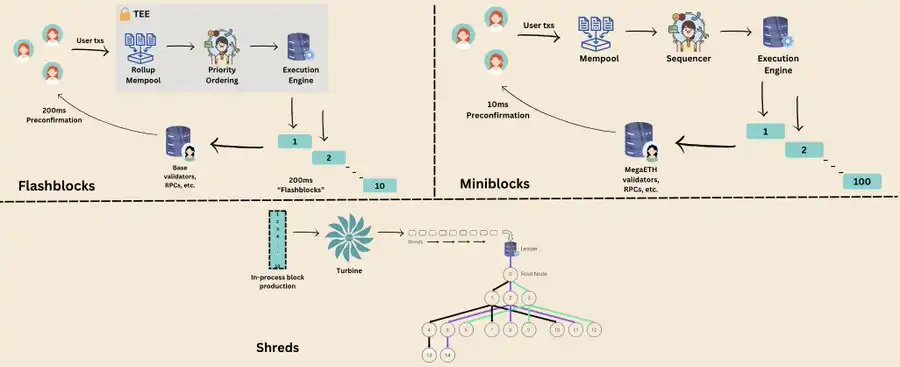
Flashblocks, Miniblocks, and Shreds are each blockchain producer's form of "pre-confirmation." Pre-confirmation is the "trusted assurance" users receive to ensure their transactions will be included in the next block. This optimizes user experience but adds a temporary trust assumption on the block producer.
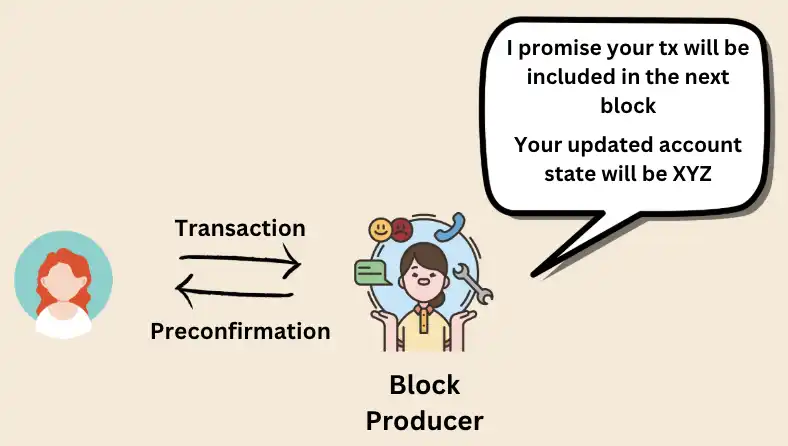
BASE FLASHBLOCKS
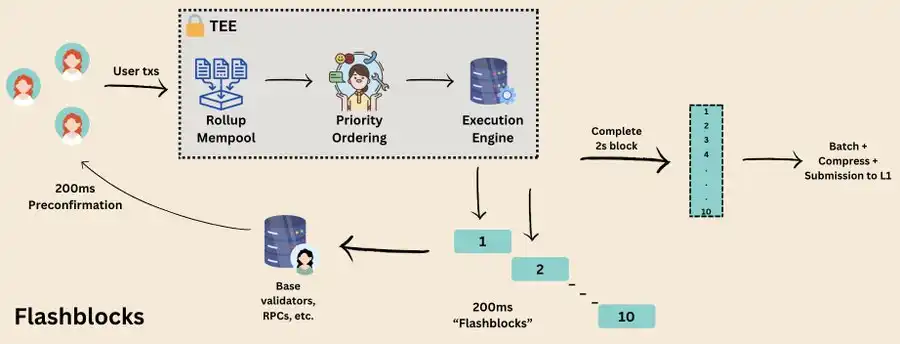
Base's block time currently stands at 2 seconds. Every 2 seconds, all tools (block explorers, RPC, wallets, etc.) fetch the block, update their database, and sync the state to the user. This state is not final (immutable) but is "pre-confirmed" by the sequencer. However, a 2-second update speed does not provide an ideal user experience, as users are accustomed to faster internet response times.
Flashblocks directly address this issue by shortening the pre-confirmation time to 200 milliseconds:
·The Sorter runs in a trusted execution environment and sorts transactions based on priority fees.
·Every 200 milliseconds, the Sorter creates a sub-block (Flashblock) and broadcasts it to L2 nodes.
·L2 nodes verify the TEE signature, issue pre-acknowledgments to users, and apply the Flashblock to local state.
·After 2 seconds, the Sorter compiles a full block, generates a Merkleized summary, and submits it to L1.
·Upon confirmation by L1, nodes update the hard state, eventually finalizing the block.
While a full block still takes 2 seconds, users can see updated state within 200 milliseconds, greatly enhancing the user experience.
MEGAETH MINIBLOCKS
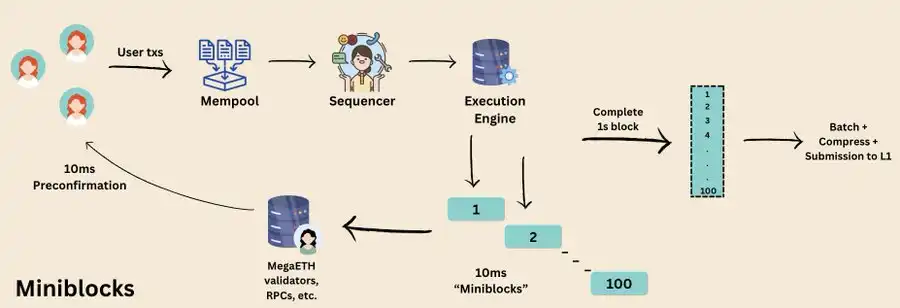
MegaETH plans to set the block time to 1 second. However, they will adopt a pre-acknowledgment strategy similar to Flashblocks to optimize user experience. The ME Sorter will continuously provide transaction confirmations (in no specific order) during the block-building process. ME plans to release pre-acknowledgments every 10 milliseconds in the form of "Miniblocks." Similar to Flashblocks, Miniblocks significantly enhance user experience without increasing the trust assumptions beyond the 1-second block time.
(It is noteworthy that while Flashblocks rely on TEE for correct execution of priority sorting, Miniblocks do not require this trust assumption.)
SOLANA SHREDS
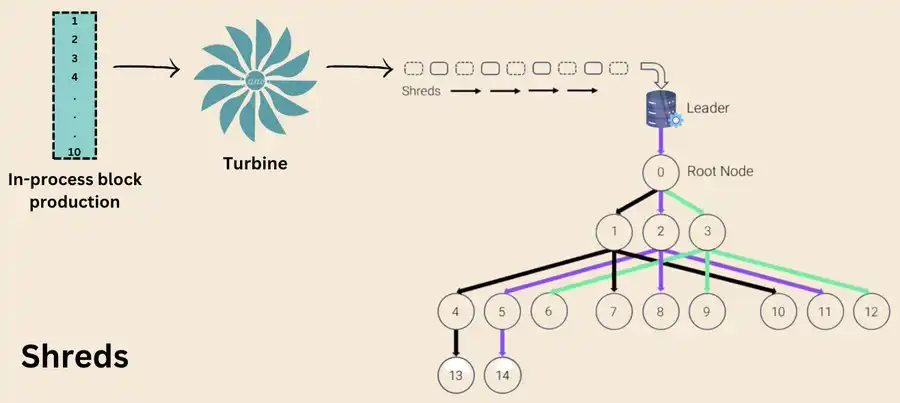
Solana is a pioneer in high-quality user experience and high-speed chains. Solana's standard block time is 400 milliseconds. During block generation, Solana's leader (block producer) splits the block into smaller "Shreds," submits them to the Proof of History (POH), and propagates them throughout the network.
Upon receiving the Shred, other validators can start replicating transactions and immediately send transaction acknowledgments upon validating the Shred (in less than 400 milliseconds).
Now there are two questions worth exploring:
1. How secure are these "preconsents" in different scenarios?
2. In the Rollup system, the final confirmation of transactions depends on batch submission to L1, so what does "block time" actually mean?
Security of Preconsents
a) Solana
Suppose a Solana validator receives two Shreds from the leader, but these Shreds are ultimately not included in the final block; there could be two scenarios:
1. Leader downtime: The final block fails to be produced, and the slot is skipped. In this case, the next leader will take over these Shreds and include them in their block (replicated onto the heaviest fork).
2. Leader malfeasance: The leader propagates different Shreds to different validators, attempting to split the network.
Therefore, the only guarantee that a transaction will be included is trusting that the leader will not act maliciously or corruptly.

b) MegaETH
MegaETH has only one sequencer, so the only assurance that transactions can be included is that the sequencer does not act maliciously.
Additionally, there are two risks:
· Sequencer downtime: Upon recovery, it will re-include previously preconfirmed transactions.
· Ethereum L1 reorg: Any L2 transactions not yet finalized will be duplicated onto the new chain by the sequencer.
c) Base
Base's preconsent mechanism is similar to MegaETH but further relies on the security of a Trusted Execution Environment (TEE).
Even if the TEE is attacked, the only thing that can be altered is the priority order of transactions, not whether they are included in the end.
In all cases, users can benefit from quicker preconsent, but this is contingent on the leader (sequencer) not acting maliciously. Since each block's leader has a monopoly on constructing the block, it is reasonable to assume that the probability of malfeasance (P) is consistent in each block construction.
What Does L2 Block Time Mean?
L1 relies on a consensus mechanism, while (most) L2 does not have a traditional consensus mechanism. On L1, the existence of block time is to improve consensus efficiency, as voting occurs at the block boundaries, and validators will vote on the correctness of the entire block's transactions.
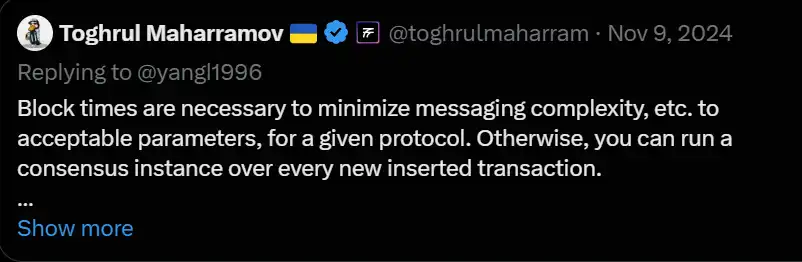
But in consensus-less L2, do we still need block time?
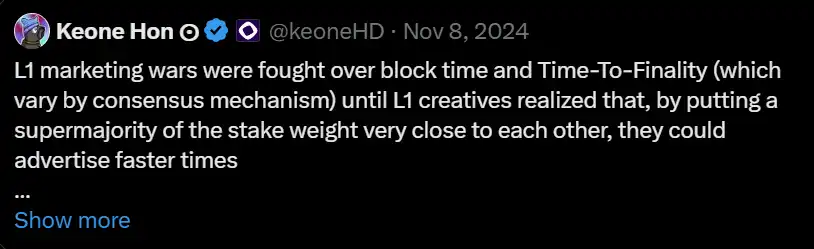
The answer is yes.
Although block time in L2 can be arbitrarily chosen and only represents "pre-finality" rather than finality, setting a fixed block time is still very helpful in many ways, including:
• Implementing mechanisms like EIP-1559 at the block level is more efficient than at a more frequent mini-block/lightning block level.
• If L2 plans for decentralized ordering and proving, well-defined block boundaries aid in the voting and proving processes.
With the improvement in blockchain performance, sub-second pre-finality will become the norm. The winning chains will also ensure a significant penalty for P (corruption), serving as a strong disincentive.
Source: "Original Post Link"
You may also like
AI Trading's Ultimate Test: Empower Your AI Strategy with Tencent Cloud to Win $1.88M & a Bentley
AI traders! Win $1.88M & a Bentley by crushing WEEX's live-market challenge. Tencent Cloud powers your AI Trading bot - can it survive the Feb 9 finals?

Russia’s Largest Bitcoin Miner BitRiver Faces Bankruptcy Crisis – What Went Wrong?
Key Takeaways BitRiver, the largest Bitcoin mining operator in Russia, faces a bankruptcy crisis due to unresolved debts…

Polymarket Predicts Over 70% Chance Bitcoin Will Drop Below $65K
Key Takeaways Polymarket bettors forecast a 71% chance for Bitcoin to fall below $65,000 by 2026. Strong bearish…

BitMine Reports 4.285M ETH Holdings, Expands Staked Position With Massive Reward Outlook
Key Takeaways BitMine Immersion Technologies holds 4,285,125 ETH, which is approximately 3.55% of Ethereum’s total supply. The company…

US Liquidity Crisis Sparked $250B Crash, Not a ‘Broken’ Crypto Market: Analyst
Key Takeaways: A massive $250 billion crash shook the cryptocurrency markets, attributed largely to liquidity issues in the…

Vitalik Advocates for Anonymous Voting in Ethereum’s Governance — A Solution to Attacks?
Key Takeaways Vitalik Buterin proposes a two-layer governance framework utilizing anonymous voting to address collusion and capture attacks,…

South Korea Utilizes AI to Pursue Unfair Crypto Trading: Offenders Face Severe Penalties
Key Takeaways South Korea is intensifying its use of AI to crack down on unfair cryptocurrency trading practices.…

Average Bitcoin ETF Investor Turns Underwater After Major Outflows
Key Takeaways: U.S. spot Bitcoin ETFs hold approximately $113 billion in assets, equivalent to around 1.28 million BTC.…

Japan’s Biggest Wealth Manager Adjusts Crypto Strategy After Q3 Setbacks
Key Takeaways Nomura Holdings, Japan’s leading wealth management firm, scales back its crypto involvement following significant third-quarter losses.…
CFTC Regulatory Shift Could Unlock New Opportunities for Coinbase Prediction Markets
Key Takeaways: The U.S. Commodity Futures Trading Commission (CFTC) is focusing on clearer regulations for crypto-linked prediction markets,…
Hong Kong Set to Approve First Stablecoin Licenses in March — Who’s In?
Key Takeaways Hong Kong’s financial regulator, the Hong Kong Monetary Authority (HKMA), is on the verge of approving…

BitRiver Founder and CEO Igor Runets Detained Over Tax Evasion Charges
Key Takeaways: Russian authorities have detained Igor Runets, CEO of BitRiver, on allegations of tax evasion. Runets is…

Crypto Investment Products Struggle with $1.7B Outflows Amid Market Turmoil
Key Takeaways: The recent $1.7 billion outflow in the crypto investment sector represents a second consecutive week of…

Why Is Crypto Down Today? – February 2, 2026
Key Takeaways: The crypto market has seen a downturn today, with a significant decrease of 2.9% in the…

Nevada Court Temporarily Bars Polymarket From Offering Contracts in the State
Key Takeaways A Nevada state court has temporarily restrained Polymarket from offering event contracts in the state, citing…

Bitcoin Falls Below $80K As Warsh Named Fed Chair, Triggers $2.5B Liquidation
Key Takeaways Bitcoin’s price tumbled below the crucial $80,000 mark following the announcement of Kevin Warsh as the…

Strategy’s Bitcoin Holdings Face $900M in Losses as BTC Slips Below $76K
Key Takeaways Strategy Inc., led by Michael Saylor, faces over $900 million in unrealized losses as Bitcoin price…
Trump-Linked Crypto Company Secures $500M UAE Investment, Sparking Conflict Concerns
Key Takeaways A Trump-affiliated crypto company, World Liberty Financial, has garnered $500 million from UAE investors, igniting conflict…
AI Trading's Ultimate Test: Empower Your AI Strategy with Tencent Cloud to Win $1.88M & a Bentley
AI traders! Win $1.88M & a Bentley by crushing WEEX's live-market challenge. Tencent Cloud powers your AI Trading bot - can it survive the Feb 9 finals?
Russia’s Largest Bitcoin Miner BitRiver Faces Bankruptcy Crisis – What Went Wrong?
Key Takeaways BitRiver, the largest Bitcoin mining operator in Russia, faces a bankruptcy crisis due to unresolved debts…
Polymarket Predicts Over 70% Chance Bitcoin Will Drop Below $65K
Key Takeaways Polymarket bettors forecast a 71% chance for Bitcoin to fall below $65,000 by 2026. Strong bearish…
BitMine Reports 4.285M ETH Holdings, Expands Staked Position With Massive Reward Outlook
Key Takeaways BitMine Immersion Technologies holds 4,285,125 ETH, which is approximately 3.55% of Ethereum’s total supply. The company…
US Liquidity Crisis Sparked $250B Crash, Not a ‘Broken’ Crypto Market: Analyst
Key Takeaways: A massive $250 billion crash shook the cryptocurrency markets, attributed largely to liquidity issues in the…
Vitalik Advocates for Anonymous Voting in Ethereum’s Governance — A Solution to Attacks?
Key Takeaways Vitalik Buterin proposes a two-layer governance framework utilizing anonymous voting to address collusion and capture attacks,…


 App
App